

There is no fixed UPI transaction limit per year set by NPCI or the Reserve Bank of India. UPI limits in India are defined on a per-transaction and per-day basis, not annually.
The standard daily cap is ₹1 lakh for most transactions, with higher limits of up to ₹5 lakh per transaction for select categories like capital markets, insurance, and tax payments.
Your effective yearly throughput depends entirely on your daily usage and your bank’s internal policies.
What Is the UPI Transaction Limit and Why Does It Exist
A UPI transaction limit is the maximum amount of money you can send or receive through the Unified Payments Interface within a defined period. These caps are set primarily by NPCI, the apex body that operates UPI, with additional oversight from the RBI.
Limits exist for two practical reasons. First, they protect users from large-scale fraud. If someone gains unauthorized access to your UPI PIN, the daily cap limits the potential financial damage.
Second, limits help maintain system stability. UPI processed over 145 billion transactions valued at more than ₹220 lakh crore in FY 2024-25.
Without transaction caps, the infrastructure would face higher settlement risk and potential overload during peak periods.
Banks also have the discretion to set their own internal limits within the NPCI-prescribed ceiling. This means your actual usable limit may be lower than the NPCI maximum, depending on which bank your account is linked to.
Is There a UPI Transaction Limit Per Year? The Simple Answer
No. NPCI does not prescribe a UPI transaction limit per year. There is no annual ceiling that resets every April or January.
UPI limits are structured on a daily and per-transaction basis. This means there is no regulatory barrier that prevents you from transacting ₹1 lakh every single day of the year if your bank permits it.
In theory, a user making full use of the standard ₹1 lakh daily limit could transfer up to ₹3.65 crore in a year. For someone using enhanced category limits of ₹5 lakh daily, the theoretical annual throughput rises even further.
However, certain banks do impose monthly caps. For example, IDFC First Bank has a UPI transaction limit of ₹30 lakh per month, while SBI has no specified monthly or yearly limit. So while NPCI itself has no yearly restriction, your bank might indirectly limit your annual volume through monthly or weekly caps.
If you frequently use UPI alongside other payment instruments, understanding the advantages of credit cards can help you plan high-value transactions that exceed standard UPI caps.
Daily and Per-Transaction UPI Limits Explained
The two limits that actually govern your UPI usage are the per-transaction limit and the daily aggregate limit.
Per-transaction limit: This is the maximum you can send in a single UPI payment. For standard P2P (person-to-person) and P2M (person-to-merchant) transfers, this cap is ₹1 lakh.
Daily limit: This is the total amount you can transfer via UPI within a 24-hour window. For most users, this is also ₹1 lakh across all UPI apps combined.
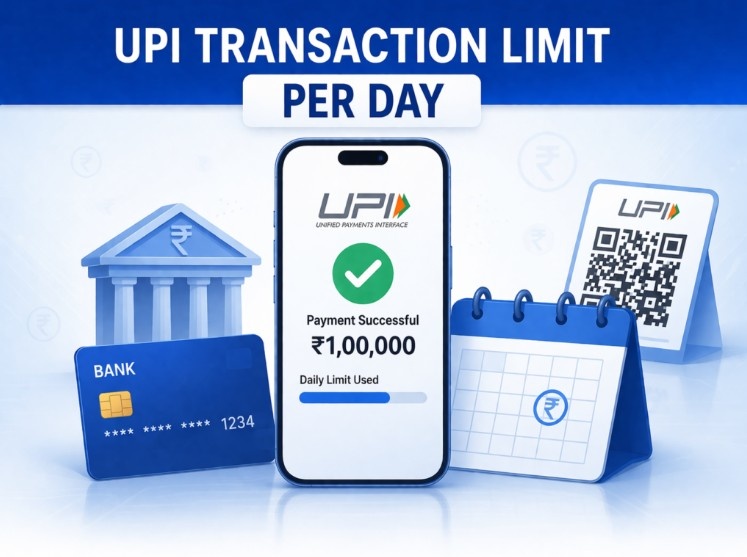
Transaction count cap: Most banks allow a maximum of 20 UPI transactions per day. Even if you have not reached the ₹1 lakh value cap, the 21st transaction will be declined.
One detail many users overlook: the daily limit follows a rolling 24-hour window from your first transaction, not a midnight reset. If you transfer ₹80,000 at 10 AM, you can only send another ₹20,000 more until 10 AM the next day.
UPI Lite and UPI 123Pay Limits
These UPI variants have separate, lower caps designed for specific use cases.
UPI Lite allows small-value offline payments without a UPI PIN. The RBI raised the per-transaction limit to ₹1,000 and the wallet limit to ₹5,000 in December 2024.
UPI 123Pay, designed for feature phone users, has a per-transaction limit of ₹10,000 after the RBI doubled it from ₹5,000 in October 2024.
| UPI Type | Pre-Transaction Limit | Daily/Wallet Limit |
|---|---|---|
| Standard UPI | ₹1,00,000 | ₹1,00,000 per day |
| UPI Lite | ₹1,000 | ₹5,000 wallet balance |
| UPI 123Pay | ₹10,000 | Bank-dependent |
Bank-Wise UPI Transaction Limits in India
While NPCI sets the maximum ceiling, individual banks can and do impose lower internal limits. This matters because your UPI experience depends on which bank account is linked to your UPI app.
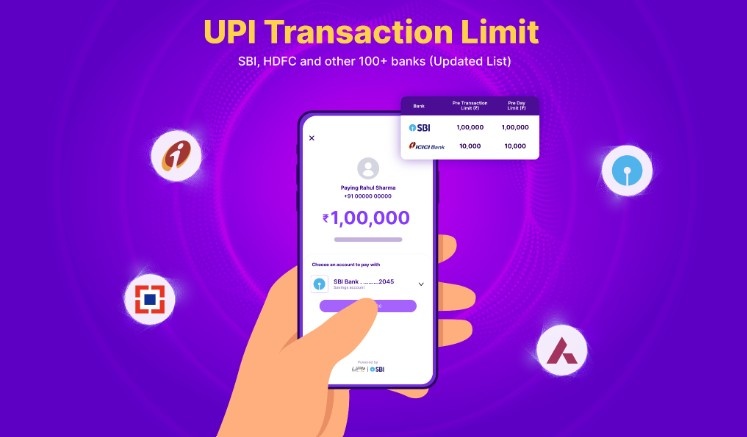
Here are the limits for major banks, based on currently available data:
| Bank | Per-Transaction Limit | Daily Limit | Transactions Per Day |
|---|---|---|---|
| SBI | ₹1,00,000 | ₹1,00,000 | 10 |
| HDFC Bank | ₹1,00,000 | ₹1,00,000 | 20 |
| ICICI Bank | ₹1,00,000 | ₹1,00,000 | 10 |
| Axis Bank | ₹1,00,000 | ₹1,00,000 | 20 |
| PNB | ₹50,000 | ₹50,000 | 20 |
| Bank of India | ₹10,000 | ₹10,000 | 20 |
| IDFC First Bank | ₹1,00,000 | ₹1,00,000 (weekly), ₹30,00,000 (monthly) | 20 |
Notice how Bank of India caps UPI at just ₹10,000 per day while SBI and HDFC allow the full ₹1 lakh. This variation is why checking your specific bank’s policy is essential before planning large payments.
For high-value needs that UPI cannot handle, some users opt to pay with a credit card instead, where individual transaction limits are typically higher.
Special UPI Limits for Categories Like Investments, Insurance, and IPOs
The most significant UPI limit changes in recent years apply to specific merchant categories, not to general transfers. Through its circular dated August 28, 2025, NPCI raised per-transaction limits to ₹5 lakh for several verified merchant categories, effective September 15, 2025.

These enhanced limits apply only to P2M (person-to-merchant) transactions with NPCI-verified merchants. P2P transfers remain capped at ₹1 lakh.
| Category | Per-Transaction Limit | 24-Hour Aggregate Limit |
|---|---|---|
| Capital Markets (MF, trading) | ₹5,00,000 | ₹10,00,000 |
| Insurance Premiums | ₹5,00,000 | ₹10,00,000 |
| Tax Payments | ₹5,00,000 | ₹5,00,000 |
| Government e-Marketplace (GeM) | ₹5,00,000 | ₹5,00,000 |
| Travel Bookings | ₹5,00,000 | ₹10,00,000 |
| Credit Card Bill Payments | ₹5,00,000 | ₹6,00,000 |
| Collections (EMI/Loan) | ₹5,00,000 | ₹10,00,000 |
| FX-Retail via BBPS | ₹5,00,000 | ₹5,00,000 |
| Education and Hospitals | ₹5,00,000 | ₹10,00,000 |
| Jewellery | ₹2,00,000 | ₹2,00,000 |
| IPO Bids (UPI Mandate) | ₹5,00,000 | As per existing norms |
A key clarification: the IPO bid limit of ₹5 lakh through UPI continues under existing norms and is separate from the capital market category enhancement.
These higher limits are a significant reason why many investors now prefer UPI over NEFT or cheques for mutual fund purchases and insurance premium payments.
If you are looking to pay taxes using digital payments, UPI now supports up to ₹5 lakh per transaction for tax categories.
Factors That Affect Your UPI Transaction Limits
Several variables can reduce your effective UPI limit below the NPCI maximum. Understanding these factors helps you avoid unexpected transaction failures.
- Your bank’s internal policy: Banks can impose lower caps based on their risk assessment. PNB limits UPI to ₹50,000 per day, while most large private banks allow the full ₹1 lakh.
- New user restriction: If you have just registered on UPI, your limit is restricted to ₹5,000 for the first 24 hours. This is an NPCI-mandated fraud prevention measure that applies across all apps. After 24 hours, normal limits activate automatically.
- UPI app differences: The BHIM app, for instance, has a daily limit of ₹40,000 with a cap of 10 transactions. Other apps like Google Pay, PhonePe, and Paytm typically allow the full ₹1 lakh.
- Account type and KYC status: Savings accounts with full KYC generally get the highest limits. Accounts with limited KYC or basic savings accounts may face lower caps.
- Device change or PIN reset: Some banks, like Federal Bank, apply a ₹5,000 aggregate limit for 24 hours after every UPI PIN set or reset. This is a security precaution that catches many users off guard.
- Cross-app aggregation: Your daily ₹1 lakh limit applies across all UPI apps linked to the same bank account. Splitting payments across Google Pay, PhonePe, and Paytm does not give you three separate ₹1 lakh limits.
How to Check Your UPI Transaction Limit
There is no single universal screen in UPI that displays your exact remaining limit. However, you have several ways to find this information.

1. Through your UPI app: Most apps like Google Pay, PhonePe, and Paytm display a transaction limit or remaining balance notification when you initiate a payment. If you are close to the daily cap, the app will typically warn you before you confirm.
2. Through your bank’s mobile banking app: Banks like HDFC, SBI, and ICICI display UPI-specific limits under the UPI settings or account management section of their apps.
3. By contacting your bank: If you cannot find the information digitally, call your bank’s customer care or visit your branch. This is especially useful if your bank applies non-standard weekly or monthly limits.
4. Through a test transaction: Attempting a small transaction can help confirm whether your UPI is active and within limits. If the payment goes through, your account is below the cap.
It is worth noting that NPCI-set limits are standardized, and users cannot change them. You can only adjust limits within the range your bank permits.
How to Increase Your UPI Transaction Limit
You cannot override the NPCI ceiling of ₹1 lakh for standard P2P and P2M payments.
However, you can take steps to ensure you are operating at the highest limit your bank allows.
1. Complete full KYC: Accounts with complete KYC documentation receive the highest possible UPI limits. If you are on a limited or minimum KYC account, upgrading to full KYC is the most effective step.
2. Contact your bank: Some banks set conservative default UPI limits that can be increased upon request. For example, if your bank has capped your daily limit at ₹25,000, you may be able to request an increase to ₹1 lakh through net banking or by visiting a branch.
3. Use category-specific limits: If your payment falls under a category like capital markets, insurance, education, or healthcare, you automatically qualify for the enhanced limit of up to ₹5 lakh per transaction. No separate application is needed. The merchant must be verified under the relevant NPCI category.
4. Link a higher-limit bank account: If your current bank imposes a low cap, linking a second bank account from a bank that allows the full ₹1 lakh can solve the problem immediately.
5. Wait out the new user period: If you are a new UPI user facing the ₹5,000 first-24-hour restriction, simply wait for the period to pass. The standard limits will apply automatically.
For recurring high-value payments like rent or property tax, exploring options like using a credit card for property tax payments can complement your UPI usage when daily caps feel restrictive.
Conclusion: UPI has no Yearly Transaction Limit
NPCI and RBI regulate UPI through daily and per-transaction limits, not annual ones.
The standard cap is ₹1 lakh per day for most users, with enhanced limits of up to ₹5 lakh per transaction available for verified categories like investments, insurance, and tax payments.
Your actual limit depends on your bank’s internal policies, your KYC status, and the type of transaction. Always check with your bank before planning large UPI transfers.
FAQs
There is no annual cap set by NPCI. However, most banks limit you to 20 transactions per day. Over a year, that allows roughly 7,300 transactions if you transact every day. Some banks also impose monthly caps that indirectly limit your yearly volume.
No. UPI uses a rolling 24-hour window that starts from your first transaction. If you transact at 3 PM, the limit resets at 3 PM the next day, not at midnight.
No. UPI Lite operates on a separate wallet with its own cap of ₹5,000. Transactions made through UPI Lite are not deducted from your standard daily UPI limit.
As of now, the RBI has confirmed that the P2P limit will remain at ₹1 lakh. In April 2025, the RBI gave NPCI the authority to revise P2M limits, but explicitly stated that the P2P cap stays unchanged.