

The maximum limit of UPI is ₹1 lakh per transaction for standard person-to-person transfers. For select merchant categories such as insurance, capital markets, and tax payments, NPCI has raised the per-transaction cap to ₹5 lakh, with a daily aggregate of up to ₹10 lakh.
However, your actual limit depends on your bank, account type, and transaction category. Here is everything you need to know about UPI transaction limits in India.
Daily UPI Transaction Limit Set by Banks in India
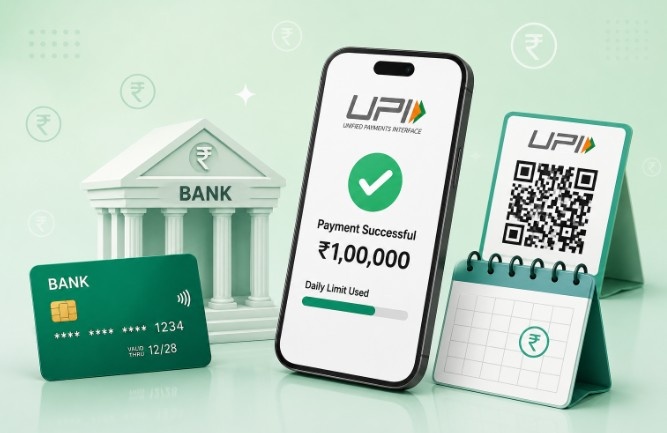
The NPCI standard daily UPI limit is ₹1,00,000 for most individual users. This cap covers the total value of all UPI transactions from a single bank account in a rolling 24-hour window.
It applies across all UPI apps linked to that account. If you use Google Pay, PhonePe, and Paytm with the same bank account, the ₹1 lakh daily cap applies to your combined spending across all three apps.
Most major banks also cap the number of outgoing transactions. The typical range is 10 to 20 transactions per day per bank account.
Even if you have not hit the ₹1 lakh value cap, your payment can fail if you cross the transaction count limit.
Here is how daily limits vary across major banks:
| Bank | Per Transaction Limit | Daily Limit | Max Transactions/Day |
|---|---|---|---|
| State Bank of India (SBI) | ₹1,00,000 | ₹1,00,000 | 10 |
| HDFC Bank | ₹1,00,000 | ₹1,00,000 | 20 |
| ICICI Bank | ₹1,00,000 | ₹1,00,000 | 10 |
| Axis Bank | ₹1,00,000 | ₹1,00,000 | 20 |
| Kotak Mahindra Bank | ₹1,00,000 | ₹1,00,000 | 20 |
| Punjab National Bank (PNB) | ₹25,000 | ₹50,000 | 10 |
| Bank of India | ₹10,000 | ₹1,00,000 | 10 |
| Bank of Baroda | ₹25,000 | Not fixed | 10 |
| Canara Bank | ₹1,00,000 | ₹1,00,000 | 20 |
| Union Bank of India | ₹1,00,000 | ₹2,00,000 | 20 |
Notice the significant differences. PNB allows only ₹25,000 per transaction, while SBI allows the full ₹1,00,000. These variations matter when planning large payments.
If you are comparing payment methods for everyday spending, understanding the differences between credit cards and debit cards is useful. UPI transactions are directly linked to your bank balance, similar to a debit card.
Per Transaction UPI Limit Across Banks and Apps
The standard per-transaction UPI limit for regular payments is ₹1,00,000. This applies to both person-to-person (P2P) and general person-to-merchant (P2M) transactions.
However, NPCI introduced significantly higher per-transaction limits for specific merchant categories. These enhanced caps, effective from September 15, 2025, apply only when paying verified merchants in eligible sectors.
Enhanced Per-Transaction Limits by Category
| Transaction Category | Per-Transaction Limit | Daily Aggregate Limit |
|---|---|---|
| Capital Markets (Mutual Funds, Stocks) | ₹5,00,000 | ₹10,00,000 |
| Insurance Premiums | ₹5,00,000 | ₹10,00,000 |
| Tax Payments | ₹5,00,000 | ₹10,00,000 |
| Travel Bookings | ₹5,00,000 | ₹10,00,000 |
| Government e-Marketplace (GeM) | ₹5,00,000 | ₹10,00,000 |
| Credit Card Bill Payments | ₹5,00,000 | ₹6,00,000 |
| Collections (EMI/Loan Repayments) | ₹5,00,000 | ₹10,00,000 |
| Jewellery Purchases | ₹2,00,000 | ₹6,00,000 |
| FX Retail via BBPS | ₹5,00,000 | ₹5,00,000 |
| Term Deposit Account Opening | ₹5,00,000 | ₹5,00,000 |
| Initial Account Funding | ₹2,00,000 | ₹2,00,000 |
| Standard P2P Transfer | ₹1,00,000 | ₹1,00,000 |
This is a major shift for users who regularly pay large insurance premiums or invest in mutual funds. Previously, a ₹3 lakh premium required multiple transactions. Now, a single UPI payment completes the job.
For those using UPI to clear high credit card bills, the ₹5 lakh ceiling removes the need for NEFT or RTGS. Understanding the advantages of credit cards helps you decide whether combining credit card spending with UPI bill payments works for you.
Important: These enhanced limits apply only to verified merchants. Your bank must confirm the merchant falls under the eligible category before activating the higher cap.
Why UPI Has a Transaction Limit in India
UPI transaction limits exist for three important reasons.
- Fraud prevention is the biggest one. Capping transaction amounts reduces the damage if someone gains unauthorised access to your UPI PIN. Without limits, a single breach could drain an entire account.
- System stability is another factor. UPI processed over 145 billion transactions worth more than ₹220 trillion in FY 2024-25. Limits help the banking infrastructure handle this massive volume without outages or failures during peak hours.
- Regulatory compliance rounds out the picture. The RBI sets the overarching framework, and NPCI implements specific caps within it. Banks then apply their own internal limits based on risk assessment.
This layered approach balances user convenience with financial security.
Without these guardrails, the UPI ecosystem would face significantly higher fraud rates and more frequent technical breakdowns.
How UPI Limits Differ for Individuals and Businesses
UPI limits are not the same for every type of user. The distinction between individual and business accounts creates different caps and rules.
For individual users:
- Standard daily limit is ₹1,00,000 for P2P and general P2M
- Enhanced limits up to ₹5,00,000 apply only to specific merchant categories
- Transaction count is typically 10 to 20 per day
- P2P transfers remain firmly capped at ₹1,00,000 per day
For business and merchant accounts:
- Businesses can receive payments above ₹1,00,000 if their category qualifies for enhanced limits
- The daily aggregate can go up to ₹10,00,000 in eligible sectors
- Banks determine internal caps for business accounts based on turnover, compliance history, and risk profile
- Acquiring banks must verify that merchant classification follows NPCI guidelines before enabling higher limits
Key difference: The RBI confirmed on April 9, 2025, that NPCI now has the authority to revise P2M transaction limits based on evolving market needs. However, P2P limits remain unchanged at ₹1 lakh. This means merchant-facing limits will likely continue expanding, while individual-to-individual transfers stay at the current cap.
UPI Lite and UPI 123Pay: Separate Limit Structures
Many users confuse UPI Lite and UPI 123Pay limits with standard UPI limits. These are separate payment rails with their own distinct caps.
UPI Lite
UPI Lite is an on-device wallet feature designed for small, frequent payments. It does not require your UPI PIN for transactions and does not count toward your standard ₹1 lakh daily limit.
| Parameter | UPI Lite Limit |
|---|---|
| Per Transaction Limit | ₹1,000 |
| Maximum Wallet Balance | ₹5,000 |
| Daily Spending Cap | ₹10,000 |
Since UPI Lite transactions run on a separate wallet, they do not consume your regular UPI daily limit. This makes it a smart way to handle small purchases like tea, parking, or bus tickets without eating into your ₹1 lakh cap for larger transfers.
UPI 123Pay
UPI 123Pay is built for feature phone users who do not have a smartphone or internet connection. The per-transaction limit is ₹10,000 for P2P payments and ₹1,00,000 for merchant payments.
These alternative UPI products extend digital payments to users with basic connectivity, but their limit structures are entirely independent of standard UPI.
Factors That Affect Your UPI Transaction Limit
Your UPI limit is not fixed at ₹1 lakh for everyone. Several factors can push it lower or qualify you for higher caps.
1. Bank policy is the most common variable. While NPCI sets the ceiling, banks can impose lower internal caps. PNB, for instance, restricts per-transaction UPI payments to ₹25,000, even though NPCI allows ₹1,00,000. If you are planning to pay taxes through digital channels, knowing your bank’s specific limits prevents failed payments during deadline periods.
2. The new user cooling period restricts first-time UPI users to ₹5,000 for the first 24 hours after registration. The same restriction applies if you change your phone or SIM card. After 24 hours, the limit reverts to your bank’s standard cap.
3. Account type matters as well. Savings accounts, salary accounts, and current accounts may have different UPI limits, even within the same bank. Current accounts typically offer higher limits due to their commercial nature.
4. Transaction category determines whether you qualify for enhanced limits. Only verified merchants in NPCI-designated categories can accept payments above ₹1 lakh. Regular P2P transfers will always be capped at ₹1 lakh regardless of your bank.
5. KYC status and account age also play a role. Banks may set lower limits for accounts with incomplete KYC or limited transaction history, then gradually increase them as the account matures.
What Happens When You Cross the UPI Limit
When you attempt a transaction that exceeds your UPI limit, the payment fails immediately. No money is debited from your account.
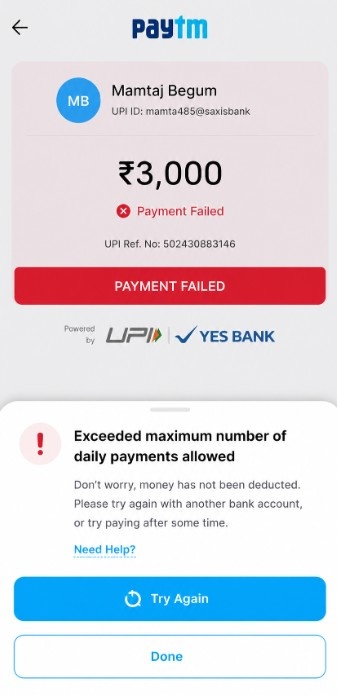
Your UPI app will display an error such as “Transaction limit exceeded” or “You have exceeded the maximum transaction amount set by your bank.”
Here is what triggers a limit-related failure:
- You try to send more than your bank’s per-transaction cap in a single payment
- Your total daily spending across all UPI apps exceeds the daily aggregate limit
- You have completed the maximum number of allowed transactions (typically 10 to 20) for the day
- You are a new user trying to send more than ₹5,000 within the first 24 hours
What you can do when this happens:
- Wait for the 24-hour window to reset and retry
- Use a different bank account linked to your UPI app
- Switch to NEFT, RTGS, or net banking for the specific payment
- Split the amount into smaller transactions if you have not hit the count limit
Your money is not at risk during a limit-related failure. The transaction simply does not go through.
However, if money gets debited but the recipient does not receive it, the amount is typically auto-reversed within 48 hours.
How to Increase UPI Limit Safely Through Your Bank
You cannot directly increase the NPCI-prescribed ceiling of ₹1 lakh for standard UPI transactions. However, there are legitimate ways to work within and potentially expand your effective limits.
Contact your bank for internal limit adjustments. Some banks set conservative default limits below the NPCI cap. A call to customer service or a branch visit can sometimes get these raised to the NPCI maximum.

For example, Bank of India’s default per-transaction limit is ₹10,000, but the daily cap is ₹1,00,000. This leaves room for adjustment.
Complete full KYC. Banks may restrict UPI limits for accounts with pending or incomplete KYC. Updating your KYC ensures you get the maximum limit your bank allows.
Use UPI for eligible high-value categories. If you need to pay insurance premiums, invest in mutual funds, or clear credit card bills, the enhanced ₹5 lakh limit applies automatically when paying verified merchants.
Link multiple bank accounts. The daily limit applies per bank account. Linking a second account to your UPI app effectively doubles your available daily limit. Each linked account gets its own ₹1 lakh cap.
Use UPI Lite for small payments. Routing everyday micro-transactions through UPI Lite preserves your standard ₹1 lakh limit for larger transfers. This is a practical strategy if you make many small payments throughout the day.

Avoid third-party limit increase schemes. Any service or app claiming to raise your UPI limit beyond NPCI guidelines is likely fraudulent. Limit adjustments happen only through your bank or through NPCI-approved category enhancements.
Common Issues Users Face With UPI Payment Restrictions
Even experienced UPI users run into limit-related problems. Understanding these common issues helps you avoid them.
Issue 1: “Limit exceeded” error despite having a balance.
This happens when you hit either the daily value cap or the transaction count cap. These limits apply across all UPI apps combined, not per app. For example, if you send ₹80,000 on Google Pay and try to send ₹30,000 on PhonePe using the same bank account, the second transaction will fail.
Issue 2: ₹5,000 cap on a new device.
Switching phones, changing SIM cards, or registering a new UPI ID triggers a 24-hour cooling period with a ₹5,000 cap. This is a security measure, not a permanent restriction. Wait 24 hours, and the full limit restores.
Issue 3: Different limits on different apps.
Your limit is determined by your bank, not your UPI app. Google Pay, PhonePe, and Paytm all follow the same bank-level limits for the same account. If limits seem different, it may be because you have linked different bank accounts to different apps.
Issue 4: Enhanced limits are not working for eligible payments.
Not all merchants in eligible categories have been verified yet. If your ₹3 lakh insurance premium fails via UPI, the insurer’s payment gateway may not yet be classified by NPCI. Contact the merchant or try another payment method.
Issue 5: Confusion between UPI Lite and regular UPI limits.
UPI Lite has separate, much lower caps. If you accidentally route a payment through UPI Lite instead of standard UPI, it will fail for any amount above ₹1,000.
Conclusion: UPI’s maximum limit ranges from ₹1 lakh to ₹5 lakh
Understanding the maximum limit of UPI helps you plan your digital payments without disruptions. For standard transfers, the ₹1,00,000 daily cap set by NPCI remains the baseline. Enhanced limits of up to ₹5,00,000 per transaction apply for categories like insurance, capital markets, and tax payments.
Your actual limit also depends on your bank’s internal policies. Since NPCI now has RBI authority to revise P2M limits further, these caps will likely evolve. Checking with your bank before initiating large UPI payments is always a good step.
FAQs
No. Person-to-person UPI transfers are capped at ₹1,00,000 per day. The enhanced limits of ₹5 lakh apply only to verified merchant payments in specific categories. The RBI confirmed in April 2025 that P2P limits remain unchanged.
No. UPI Lite operates as a separate on-device wallet with its own caps of ₹1,000 per transaction and ₹5,000 wallet balance. Payments through UPI Lite do not count toward your standard ₹1 lakh daily UPI limit.
This typically happens during the first 24 hours after a new UPI registration, a device change, or a SIM swap. It is a temporary security restriction that lifts automatically after 24 hours.
Yes. UPI limits are set by your bank, not the app. All UPI apps follow the same bank-level caps. The daily limit applies cumulatively across all apps linked to the same bank account.
The RBI authorised NPCI in April 2025 to revise P2M transaction limits based on market needs. This suggests further category-level increases are likely. However, no announcement has been made about raising the standard P2P limit beyond ₹1 lakh.