

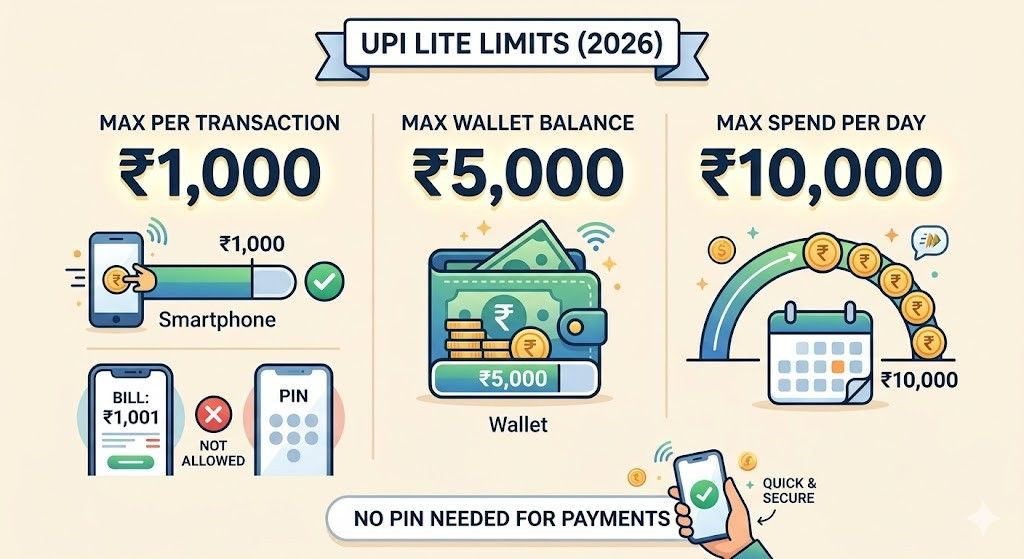
The limit per transaction is ₹1,000, the wallet holds up to ₹5,000, and you can spend up to ₹10,000 in a day, all without entering a PIN.
You are at a tea stall, the bill is ₹30. You open your UPI app, type the amount, and wait. The bank server takes time, and the payment fails.
UPI Lite fixes this. Standard UPI is for big payments. UPI Lite is for the small ones you make every day, chai, bus ticket, and vegetables. No PIN. No waiting. The payment goes through in seconds.
UPI Lite Limit For Each Payment And the Wallet
Each payment through UPI Lite can be up to ₹1,000. If your bill is ₹1,001, UPI Lite will not work for that payment. The app switches to standard UPI and asks for your PIN.
These numbers put it all in one place:
| Feature | Limit in 2026 |
|---|---|
| Max Per Transaction | ₹1,000 |
| Max Wallet Balance | ₹5,000 |
| Max Spend Per Day | ₹10,000 |
| PIN Needed? | No |
The wallet holds money you move from your bank account. Think of it as a small pocket inside your phone. You can keep up to ₹5,000 in this pocket at any time.
This money does not earn interest. It is just a part of your bank balance that sits on your phone, ready to use without a PIN every time.
How UPI Lite Changes Your Bank Statement
Every time you pay with UPI Lite, that payment does not show in your bank passbook.
Only the top-up shows. So if you load ₹500 into your wallet and make 10 payments with it, your bank statement shows one line for the ₹500 top-up. Not 10 lines.
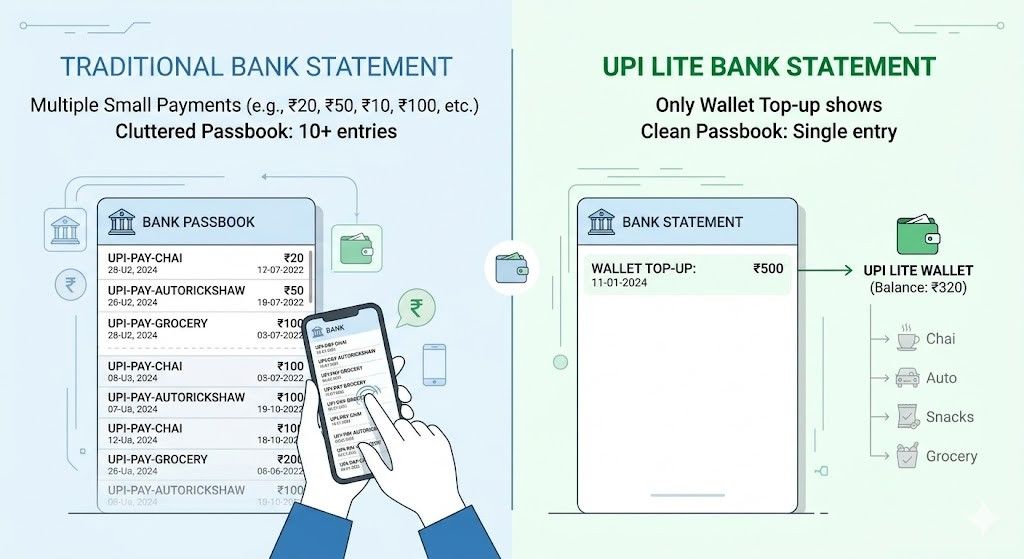
This helps when you apply for a home loan or file your taxes. Banks and accountants look at your statement. Fewer lines mean less time to go through it. UPI Lite does this for you without any extra work on your end.
UPI Lite vs UPI Lite X
UPI Lite needs the internet to work. UPI Lite X does not. UPI Lite X uses NFC. You tap your phone near a payment terminal, and the payment goes through, even with no signal.
Because UPI Lite X works without the internet, the limits are lower. If something goes wrong with an offline payment, it is harder to fix. So NPCI keeps the cap low to reduce the risk.
Here is how both compare:
| Feature | UPI Lite | UPI Lite X |
|---|---|---|
| Needs Internet? | Yes | No (Uses NFC) |
| Max Per Transaction | ₹1,000 | ₹500 |
| Max Wallet Balance | ₹5,000 | ₹2,000 |
| Max Per Day | ₹10,000 | ₹4,000 |
| Works Best In | Markets, shops | Metro, basement, no-signal areas |
One thing to keep in mind with UPI Lite X: if you pay offline, your phone needs to come online within 4 days. After that, the payment gets confirmed, and your records are updated. No GST is charged on this UPI transaction.
Source: bhimupi.org
Auto Top-Up: So Your Wallet Does Not Run Out
If your wallet runs empty in the middle of the day, you have to stop and top it up manually. Auto Top-Up removes that step.
Auto top-up works like a UPI mandate. You set a limit. When your wallet balance falls below that limit, the app pulls money from your bank account and fills the wallet on its own. You set it once. After that, it runs on its own.
A few things to know:
- You choose the threshold, the point where the refill starts
- The wallet can auto top-up up to 5 times a day
- The balance cannot go above ₹5,000 after any refill
How to turn on Auto Top-Up on Google Pay or PhonePe:
- Open the app and go to UPI Lite
- Find “Auto Top-Up” or “Auto Reload”
- Set the amount at which the refill should start (example: ₹200)
- Set how much to add each time (example: ₹1,000)
- Enter your UPI PIN once to confirm
The app handles everything after that.
Your Money Is Safe Inside the Wallet
People ask: if someone steals my phone, can they take money from my UPI Lite wallet?
They can only access what is in the wallet at that time. The wallet holds at most ₹5,000. Most people carry much less than that. So the loss is limited.
You can also turn off UPI Lite at any time. When you do, the wallet balance goes back to your bank account.
If your phone is lost or stolen, call your bank and ask them to block the UPI Lite wallet. The bank will work to return whatever balance is left.
Keep your phone screen locked. UPI Lite does not ask for a PIN on each payment, so the screen lock is the one thing that keeps others from using your wallet.
Related Read:
Conclusion: The Limits Work For Most Daily Payments
For tea, groceries, bus rides, and small shops, the limits cover what you need.
Use UPI Lite for payments under ₹1,000 when you want speed and a clean bank statement.
Use standard UPI for anything above ₹1,000 or when you need the payment to show in your bank records.
FAQs
UPI Lite is faster for small payments and needs no PIN. Standard UPI works for bigger amounts and keeps a full bank record. Use both for different needs.
Some older app versions or banks still show ₹2,000. The current NPCI limit is ₹5,000. Update your app and check if your bank supports the new limit.
Not with UPI Lite. Standard UPI allows up to ₹1 lakh per transaction for most banks. Some categories, like tax payments, allow up to ₹2 lakhs.
No PIN means no second check before each payment. The wallet earns no interest. Small payments do not show in your bank statement. Not every bank supports it.
Yes. You can spend up to ₹10,000 per day. For UPI Lite X (offline), the daily limit is ₹4,000.
Yes. The wallet holds at most ₹5,000. You can turn off the wallet anytime and the balance goes back to your bank.
Standard UPI asks for a PIN on every payment, so it has more checks. UPI Lite skips the PIN but keeps the risk low with a small wallet limit.
Yes. It can fail if the wallet balance is low, the app has an error, or NFC does not work (for Lite X). Internet-based UPI Lite fails less often than offline Lite X.