

IMPS is best for sending money instantly, while NEFT is better for large or planned payments. IMPS sends money in real-time within seconds, making it good for urgent needs.
IMPS and NEFT are popular payment methods in India, and the RBI/NPCI regulates them. Both can be used for similar and different purposes.
This article will help you understand the differences in speed, charges, limits, availability, and when to use each one.
IMPS vs NEFT: Key Takeaways
- IMPS sends money instantly (within seconds), while NEFT takes 30 minutes to 2 hours
- IMPS lets you send up to ₹5 lakh per transaction, but NEFT has no limit
- Both work 24×7, including weekends and holidays
- NEFT is usually free for online transfers, while IMPS may have small charges at some banks
- Use IMPS when you need money to reach immediately (like emergencies)
- Use NEFT when you’re sending large amounts or when speed doesn’t matter
- Both are equally safe and regulated by RBI/NPCI
IMPS vs NEFT Comparison Table
Here’s a side-by-side comparison of IMPS vs NEFT to help you decide.
| Feature | IMPS | NEFT |
|---|---|---|
| Full Form | Immediate Payment Service | National Electronic Funds Transfer |
| Settlement Speed | Instant (real-time) | 30 minutes to 2 hours (batch-based) |
| Availability | 24×7, 365 days | 24×7, 365 days |
| Minimum Limit | ₹1 | ₹1 |
| Maximum Limit | ₹5 lakh (bank-dependent) | No maximum limit |
| Charges | ₹2.50–₹25 + GST (often free online) | Mostly free online |
| Best For | Urgent transfers | Large, non-urgent payments |
| Managed By | NPCI | RBI |
IMPS is best for urgent money transfers, while NEFT is better for large payments that are not time-critical. Let’s understand both in more detail:
IMPS vs NEFT: Key Details
Let’s first understand what these two payment methods are and how they work.
What Is IMPS?
IMPS means Immediate Payment Service. It is run by the National Payments Corporation of India (NPCI).

The main thing about IMPS is that it sends money instantly, and your money reaches the other person’s account within seconds.
You can use IMPS through:
- Mobile banking apps
- Internet banking
- ATM machines
- SMS or phone banking
IMPS works all day and night, including holidays, weekends, and late hours. For example, if you need to send ₹10,000 to someone at 11 PM on a Sunday, IMPS will send it right away, and the person will get the money within seconds.
What Is NEFT?
NEFT means National Electronic Funds Transfer. It is run by the Reserve Bank of India (RBI).
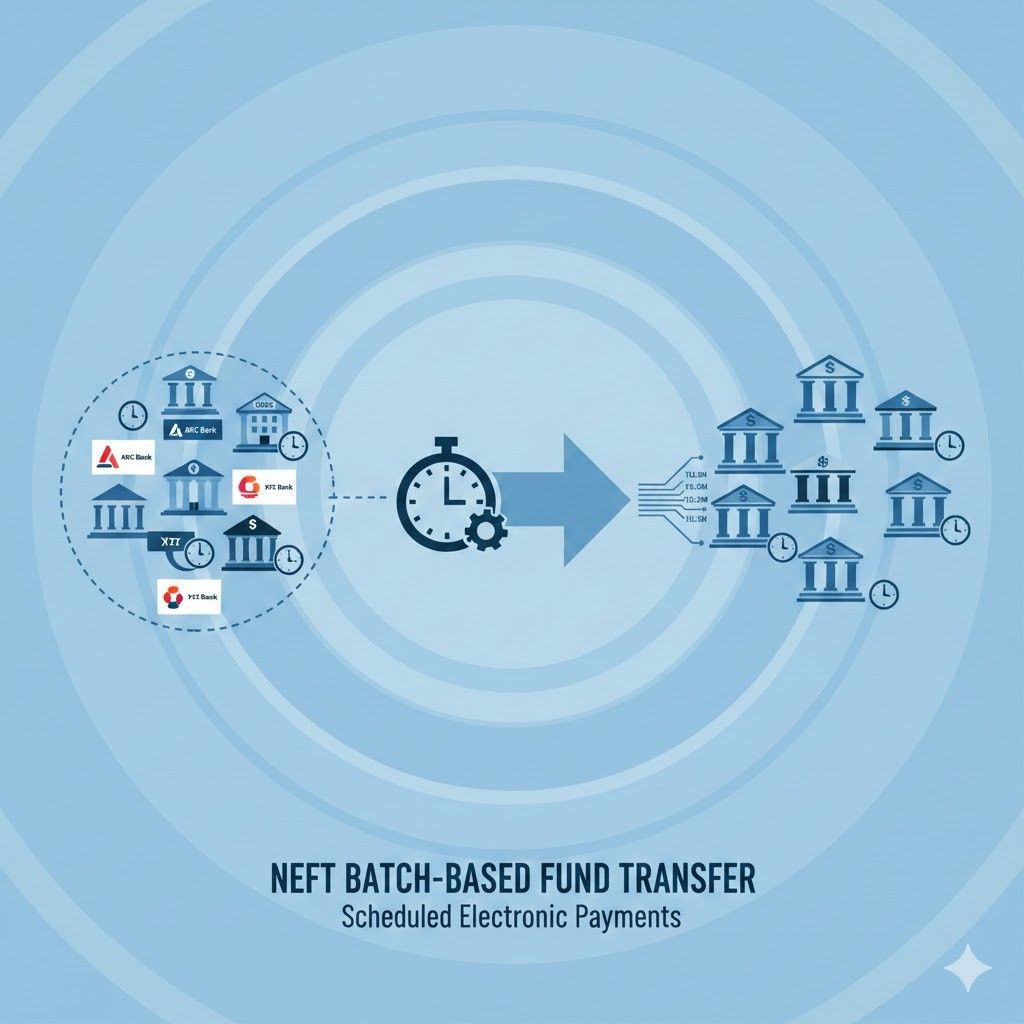
Unlike IMPS, NEFT processes transactions in groups every 30 minutes instead of instantly.
NEFT is now available 24×7 . People commonly use it for:
- Monthly rent payments
- Loan EMIs
- Credit card bill payments
- Business transactions
NEFT has government backing and strong safety measures. It also lets you send money to Nepal with a limit of ₹50,000 per transaction.
Because there’s no maximum limit on NEFT transfers, it works well for large payments where you don’t need the money to reach immediately.
For example, if you’re paying ₹15 lakh for buying a house, NEFT lets you transfer the full amount in one go.
IMPS vs NEFT Time Taken – Which Is Faster?
Here are the timings that are needed by IMPS and NEFT processes:
| Mode | Processing Type | Time Taken |
|---|---|---|
| IMPS | Real-time | Seconds |
| NEFT | Batch-based | 30 minutes to 2 hours |
IMPS is faster. It sends money in real-time, which means the money reaches the other person within seconds.
For example, if you send ₹5,000 via IMPS at 3 PM, the person will see the money in their account by 3:00:15 PM.
NEFT works in batches. Banks process NEFT transactions in groups every 30 minutes.
Because of this, your transfer can take anywhere from 30 minutes to 2 hours. The exact time depends on when you send the money and when the next batch happens.
For example, if you send money via NEFT at 2:15 PM and the next batch starts at 2:30 PM, your payment might finish by 2:45 PM.
However, if there’s any delay at the receiving bank, it could take up to 2 hours.
People call NEFT “near real-time” because most transfers complete within an hour, though it’s not as fast as IMPS.
IMPS vs NEFT Charges – Which Is Cheaper?
Now let’s look at the charges for each service.
| Amount Slab | NEFT Charges (Max) | IMPS Charges (Typical) |
|---|---|---|
| Up to ₹10,000 | ₹2.50 + GST | ₹2.50–₹5 |
| ₹10,001 – ₹1 lakh | ₹5 + GST | ₹5–₹10 |
| ₹1–2 lakh | ₹15 + GST | ₹10–₹15 |
| Above ₹2 lakh | ₹25 + GST | ₹15–₹25 |
NEFT is usually cheaper or free for most people. The RBI has set maximum charges for NEFT, and many banks don’t charge anything for NEFT transfers done through internet banking or mobile apps on savings accounts.
IMPS charges depend on how much money you transfer. Many banks offer free IMPS transactions when done online, though some banks still charge a fee.
For example, if you transfer ₹50,000 through NEFT online, most banks won’t charge you anything. The same ₹50,000 via IMPS might cost you ₹5-₹10 plus GST at some banks, while other banks may offer it free.
Important: GST is charged only on the service fee, not on the amount you’re transferring.
IMPS vs NEFT Limits – Minimum and Maximum Transfer Amount
Both IMPS and NEFT let you transfer as little as ₹1. There’s no difference in the minimum amount.
The big difference is in the maximum limit. IMPS has a maximum limit of₹5 lakh per transaction.
However, this limit can be different depending on your bank and how you send the money (mobile app, internet banking, or ATM).
NEFT has no maximum limit. This makes NEFT the right choice for business transactions and large personal payments like buying property or making big investments.
IMPS vs NEFT Availability – Night, Weekend & Holiday Transfers
Both IMPS and NEFT work 24×7, all year long. In December 2019, the RBI made NEFT available 24×7.
Even though both work all the time, IMPS is better when you need to send money urgently. This is because IMPS is instant, while NEFT still takes time, even during odd hours.
For example, if you need to send ₹20,000 at 2 AM on a Saturday night, IMPS will send it within seconds.
While NEFT might take 30 minutes to 2 hours, depending on the batch processing schedule. Both services work properly during bank holidays, weekends, and late-night hours.
IMPS vs NEFT – Which Is Better and When to Use What?
Let’s look at real situations for using each service.
Choose IMPS When You Need Instant Transfer
Use IMPS when timing is important. Here are situations where IMPS is the better choice:
- Medical emergencies where you need to pay immediately. For example, paying a hospital deposit of ₹50,000 at midnight.
- Sending money to family or friends who need it right away. For instance, your child needs ₹5,000 for a hostel fee payment today.
- Bills with same-day deadlines. For example, an electricity bill that will lead to disconnection if not paid by the end of the day.
- Weekend or holiday payments when waiting isn’t possible. For instance, booking a last-minute travel ticket on Sunday evening.
IMPS gives you quick confirmation, which matters when the other person needs to check if they got the money.
Choose NEFT For Large or Scheduled Payments
Use NEFT when you’re sending large amounts or when you have time. NEFT works well for:
- Monthly rent payments of ₹30,000 that you can send a day before the due date
- Loan EMIs that have a due date but don’t need instant processing. For example, a home loan EMI of ₹45,000 due on the 5th of the month
- Credit card bill payments where you have a few days before the due date.
- Business transactions with large amounts. For instance, paying ₹12 lakh to a supplier for stock
- Property deals where you need to transfer ₹25 lakh, and IMPS limit won’t work
NEFT is also good when you want to avoid charges, as it’s usually free for online transfers.
IMPS vs NEFT – Key Things To Consider Before Transferring Money
Before you transfer money through IMPS or NEFT, think about these things:
- Speed vs urgency: Check if the payment needs to reach immediately or if a 1-2 hour wait is okay.
- Amount size: For amounts above ₹5 lakh, you need to use NEFT since IMPS has a cap.
- Charges: Check your bank’s fees. If your bank charges ₹15 for IMPS but offers NEFT for free, and you’re not in a hurry, NEFT saves money.
- Daily limits: Banks set daily limits. Check these limits before planning big transfers.
- Correct details: Always check the other person’s account number, IFSC code, and name.
For example, paying school fees on the last day needs IMPS, but paying rent on the 28th when it’s due on the 1st allows for NEFT.
One wrong digit will cause the transaction to fail or send money to the wrong account.
Suggested Read:
Conclusion: IMPS Is Best For Instant Money Transfers, NEFT Works Better For Large Non-Urgent Payments
IMPS and NEFT are used for different banking needs. IMPS is fast and transfers money instantly, so it is best for urgent payments.
NEFT is usually low-cost or free and allows large transfers, making it good for planned payments. Both services work together, not against each other.
If you need to send money quickly and the amount is under ₹5 lakh, IMPS is better. For bigger payments where time is not urgent, NEFT is the right choice.
FAQs
Neither is always better; it depends on what you need. IMPS is better when you need an instant transfer. NEFT is better for large amounts above ₹5 lakh and when you have time, as it’s often free and has no maximum limit.
It depends on your bank. Many banks offer free IMPS for online transfers, while others charge ₹2.50 to ₹25 plus GST based on the amount. Check with your bank.
IMPS takes just a few seconds. The money usually reaches the other person’s account within 5-10 seconds after you confirm the transaction.
NEFT is mostly free for online transfers from savings accounts. The RBI has set maximum charges, but most banks don’t charge for NEFT done through internet banking.
The main problems are the ₹5 lakh maximum limit per transaction and possible charges at some banks. IMPS also doesn’t work for very large business payments that go beyond this limit.
IMPS can cost more as some banks charge fees based on how much you transfer. NEFT is usually free for online transfers. However, many banks now offer both services free for online transactions.
IMPS is instant, even at night, processing within seconds. NEFT works in batches even at night, taking 30 minutes to 2 hours.
Both are equally safe and regulated by RBI and NPCI. They use security technology to protect transactions. Safety depends more on how carefully you enter details than on the system itself.
NEFT works 24×7 including weekends and holidays. It functions the same way on Saturday and Sunday as it does on weekdays.
It depends on the bank. Many banks offer free IMPS for online transfers, but rules vary. Some banks charge while others don’t.
NEFT is better for large amounts because it has no maximum limit. IMPS is capped at ₹5 lakh per transaction, so for amounts beyond that, NEFT is the only option.